
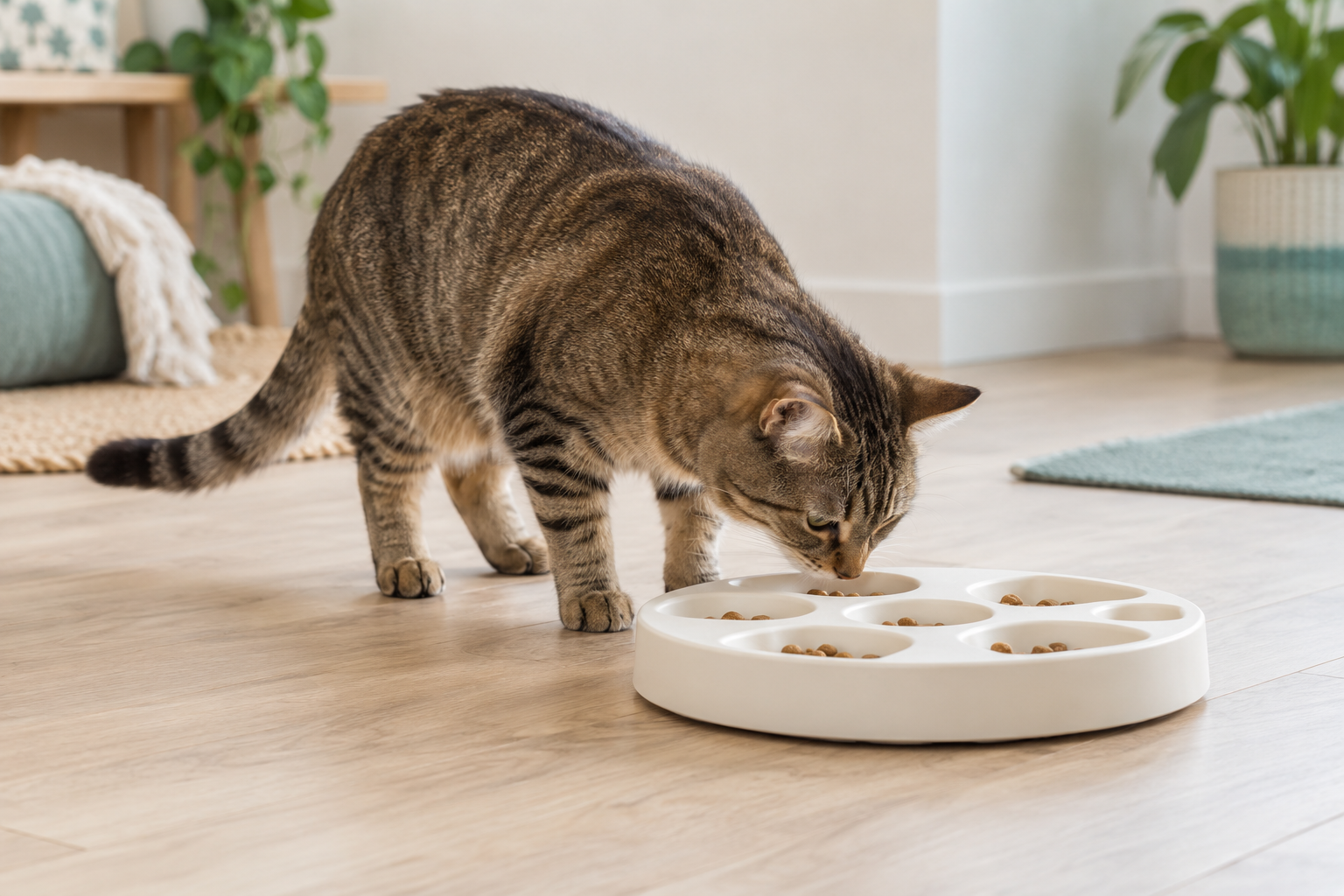
Food & Feeding Enrichment
Cats can learn to use food puzzles, but a new feeder is not self-explanatory. Start with a familiar food and an easy, stable arrangement. Offer the remaining meal in the usual way while your cat learns.
Introduce a puzzle feeder
Put a few pieces from the normal food allowance in a shallow puzzle with open compartments. Place some beside it so the first success is easy. Allow your cat to investigate without moving their paws.
Make it easier. Use a plain shallow dish or put the food at the edge of an open compartment. Keep the feeder still and remove unnecessary barriers.
Build gradually. Move food a little deeper or introduce one simple moving part. Increase complexity only when your cat is succeeding comfortably.
Keep it safe. Choose smooth, stable equipment with openings that cannot trap paws or the jaw. Supervise initially and stop if the cat bites off parts or struggles repeatedly.
Try a food-dispensing toy
Choose a lightweight dispenser that releases food with a gentle movement. Show your cat a piece falling out and let them investigate.
Make it easier. Use the largest suitable opening and a quiet, level surface. A stationary open puzzle may be easier for a hesitant cat.
Build gradually. Reduce the opening slightly once gentle movements reliably release food. Change one feature at a time.
Keep it safe. Keep the toy away from stairs and check for detachable pieces. Monitor food intake so a difficult feeder does not prevent eating.
Offer hunting-style feeding and food searches
Place small portions in a few obvious, reachable locations in a familiar room. Let your cat see the first placements. This creates opportunities to search for food without live prey.
Make it easier. Keep the portions visible and close to the normal feeding area.
Build gradually. Add one location or partly conceal a portion beside a familiar object. Keep a note of hiding places so leftovers are found.
Keep it safe. Use the normal daily allowance and separate cats if competition occurs. Avoid inaccessible shelves, contaminated surfaces, and hidden perishable food that could be forgotten.
Licking activities and slow feeding
For a cat that enjoys licking, spread a little suitable wet food on a shallow, easy-to-clean textured dish. A low-ridged slow feeder can be considered if eating remains comfortable.
Make it easier. Use a smooth shallow dish with a small accessible portion.
Build gradually. Spread the same portion across a slightly larger surface. A complicated feeder is not a necessary goal.
Keep it safe. Supervise flexible mats and remove them if chewed. Wash promptly, check crevices, and discard leftover perishable food. Keep prescribed dietary restrictions in mind.
Use part of your cat’s normal daily food allowance and account for additional treats. Do not use hunger to force participation. If appetite or intake falls, make food readily accessible and seek veterinary advice.
Training & Problem Solving
Cats can learn new skills and participate in structured training. Use a reward the individual cat values, keep sessions short, and allow them to leave. Learning should offer choice and achievable problem-solving.
Teach the Touch cue
Present an open hand or a suitable target a short distance from your cat’s nose. Immediately reward a voluntary nose touch. Remove the target between attempts. Once the movement is familiar, say “Touch” just before presenting the target.
Make it easier. Reward a small movement towards the target at first. Keep it close and let your cat approach.
Build gradually. Vary the target’s position slightly, then invite a short, comfortable movement towards it. This can support simple tricks or moving between familiar places.
Keep it safe. Do not push the target into the cat’s face, physically move the cat, or lure them into something frightening. Keep movements comfortable and allow withdrawal.
Teach the Look cue
Wait for your cat to glance towards your face in a calm, familiar setting, then immediately offer a valued reward. When these brief glances are predictable, say “Look” just before an expected glance and reward the response.
Make it easier. Reward a brief orientation towards your face. Sit nearby and keep the session short.
Build gradually. Add a little duration or one mild distraction only after your cat is responding comfortably.
Keep it safe. Do not stare at your cat or require prolonged eye contact. Never hold their head in position. A comfortable glance is enough, and the cat should be free to look away or leave.
Make carrier training an activity
Leave a stable carrier open in a familiar area with comfortable bedding. Reward investigation near it, then approaching the entrance, then a voluntary step inside. An early session may end at any one of those steps. Keep the door open during initial exploration. Work on door movement and duration separately under an appropriate plan; do not trap the cat after they follow food inside.
Simple problems and searching
Partly conceal a favourite robust toy beside a box or invite your cat to follow a target around a clear floor space. Reward progress promptly. A simple trick or search is enough; repeated failures and long sessions do not make training more enriching.
Scent & Sensory Enrichment
Offer scent and sensory experiences as choices. Introduce one mild stimulus in a familiar place, leaving a clear route away. A cat may prefer familiar smells and textures to novelty.
Catnip, silver vine, and individual variation
Responses to catnip, silver vine, other plants, and novel scents vary. One cat may roll or rub strongly; another may show a subtle response, little response, or no obvious response. A cat that ignores catnip may respond to another plant, or may simply prefer a different activity. A strong response is not necessary for enrichment.
Offer a small amount in a robust purpose-made toy, following its instructions, and supervise. Remove it if interaction becomes frantic, conflict develops, or the toy is damaged. Provide plant-based activities separately in multi-cat homes. Do not assume all parts of a plant, garden cuttings, extracts, or essential oils are safe.
Plants, objects, and textures
Cat-safe grass grown for cats can provide an opportunity to investigate or nibble. Use correctly identified, pesticide-free plants and prevent access to fertilizers or treated soil. Other plant-based products should be specifically suitable for cats; check uncertain products with your veterinary team. A clean, robust unfamiliar object or a choice of safe scratching textures may be more interesting than scent alone. Supervise and remove anything being swallowed.
Visual and auditory experiences
A secure window perch can offer observation if your cat remains comfortable. Reduce the view if outdoor animals provoke agitation. Quiet sounds may interest some cats, but constant sound is unnecessary. Start softly, allow withdrawal, and stop if your cat startles, hides, or becomes vigilant.
Physical & Play Enrichment
Interactive play can offer opportunities to stalk, chase, pounce, and capture. Move toys in ways that invite your cat’s interest, while keeping the pace and height suitable for their body.
Use a wand toy
Move the toy across the floor and briefly behind a safe object, allowing pauses for stalking. Let your cat choose whether to follow and make successful catches.
Make it easier. Move more slowly, keep the toy close, and allow frequent captures.
Build gradually. Vary the route or include a short pause behind a box. Add climbing or jumping only if physically appropriate.
Keep it safe. Keep string, ribbon, feathers, elastic components, and detachable pieces under direct supervision. Store wand toys out of reach afterwards. Do not leave strings tied to furniture or the cat.
Complete the play sequence
Allow repeated successful captures rather than endlessly keeping the toy out of reach. Gradually slow the movement, allow a final catch, and give the cat a chance to disengage. A small portion of their usual meal can follow if appropriate. Do not keep escalating play when they are trying to stop.
Movement around the home
Stable cat trees, accessible platforms, tunnels, and boxes can support exploration and movement-based games. Keep jumps appropriate to mobility and provide lower routes when needed. Use boxes without staples, tape, handles, or loose material that could be swallowed, and remove damaged cardboard. Choose tunnels without exposed wire or damaged fabric. Rotate a few safe toys while retaining favourites.
Use toys rather than hands or feet as targets. Stop if play becomes frantic, contact becomes rough, or the cat cannot disengage. Strings and small components are ingestion hazards, even when a toy is sold for cats.
Environmental Enrichment
A useful cat environment offers both exploration and withdrawal. Your cat should have places to investigate and places to retreat without disturbance.
Create a Safe Haven
A Safe Haven is a quiet indoor area where your cat can rest, hide, and withdraw without being disturbed. Offer familiar bedding, a safe hiding place, and an accessible perch if suitable. Let your cat choose to enter or leave, keep access routes clear, and prevent people or other animals from blocking the exit. In multi-cat homes, provide separate retreats so one cat cannot monopolize them.
Pheromones
A species-appropriate feline pheromone product may be used in the indoor environment or near the Safe Haven as part of your veterinary behaviour team’s plan. Synthetic pheromones are intended to mimic chemical signals used by cats. Products have different intended uses, so follow your team’s advice and the product instructions. Responses vary; pheromones should be used alongside appropriate resources, comfortable social arrangements, and individualized treatment.
Build several comfortable options
- Provide stable vertical space through cat trees, shelves, or window perches. Secure them and offer lower steps or floor-level alternatives for cats with mobility limitations.
- Offer hiding areas, boxes, and tunnels with safe access. Remove handles, staples, and loose tape from boxes and replace damaged materials. Avoid locations where another animal can trap the cat.
- Provide scratching surfaces that suit the cat’s preferences, including stable vertical and horizontal options where useful. Place them where the cat actually spends time.
- Offer several resting and observation locations. Cats should be able to choose distance from people and other animals. Keep essential resources accessible.
- For protected outdoor access, consider a secure catio with shade, shelter, and a way to return inside. Check the structure for escape gaps and hazards. Do not force a cat into an unfamiliar outdoor space.
Balance complexity with predictability
Add routes, resting places, and exploration opportunities without obstructing familiar pathways. Rotate some toys and introduce new objects gradually. Preserve preferred hiding and sleeping places, particularly for a fearful cat or one with sensory loss.
Social Enrichment
Positive social time may be play, affection your cat seeks, or simply resting near you. Individual cats differ in how close they want to be and how much handling they enjoy.
Choice and control
Let your cat approach, disengage, retreat, and control proximity. Pause during petting and look for a voluntary return before continuing. A cat can enjoy your company without wanting to be picked up or held.
When social interaction is not enrichment
An interaction is not enriching when the cat is avoiding, escaping, hiding, withdrawing, or trying to end it. Examples include:
Living with more than one cat
Some cats enjoy each other’s company; others prefer more distance. Provide separate opportunities for food enrichment, owner attention, and play. Offer multiple resting and retreat areas with clear access routes. Do not treat sharing, physical closeness, or taking turns under pressure as a goal.
One cat monopolizing a toy or quietly preventing another from approaching can signal conflict even without fighting. Separate valuable activities and follow your behaviour team’s recommendations. See multi-animal households.