
Food & Feeding Enrichment
Begin with easy success. Put a small part of your dog’s usual meal into one activity, show them where the food is, and let them choose whether to investigate. Keep the rest of the meal readily accessible while they learn.
Stuffed food toys and licking activities
A hollow food toy, such as a Kong-type toy, holds food for the dog to lick or remove. A lick mat provides a textured surface for a thin layer of an appropriate food. Start with loose pieces near a large opening or a small smear that is easy to reach.
Make it easier. Use a wider opening or shallower surface. Hold the toy steady only if your dog is comfortable with your involvement.
Build gradually. Add a little more food or fill slightly deeper once your dog succeeds calmly. A lightly chilled or partially frozen filling may extend licking for an experienced dog; freezing is optional.
Keep it safe. Choose an appropriate size and material. Supervise, especially with lick mats. Remove equipment that is chewed or torn. Avoid hard frozen items that encourage forceful biting, and check dietary suitability.
Puzzle feeders, rolling dispensers, and wobble toys
These release food when moved or manipulated. Start a puzzle with compartments open, or a rolling or wobble-style dispenser with the easiest opening and only a few pieces of food.
Make it easier. Place food beside the feeder, demonstrate a single movement, or stabilize a noisy dispenser on a non-slip surface.
Build gradually. Close one compartment or narrow the dispensing opening slightly. Change only one feature at a time.
Keep it safe. Use a clear area away from stairs. Stay nearby and stop if your dog starts smashing, biting, or swallowing parts. Choose components too large to swallow.
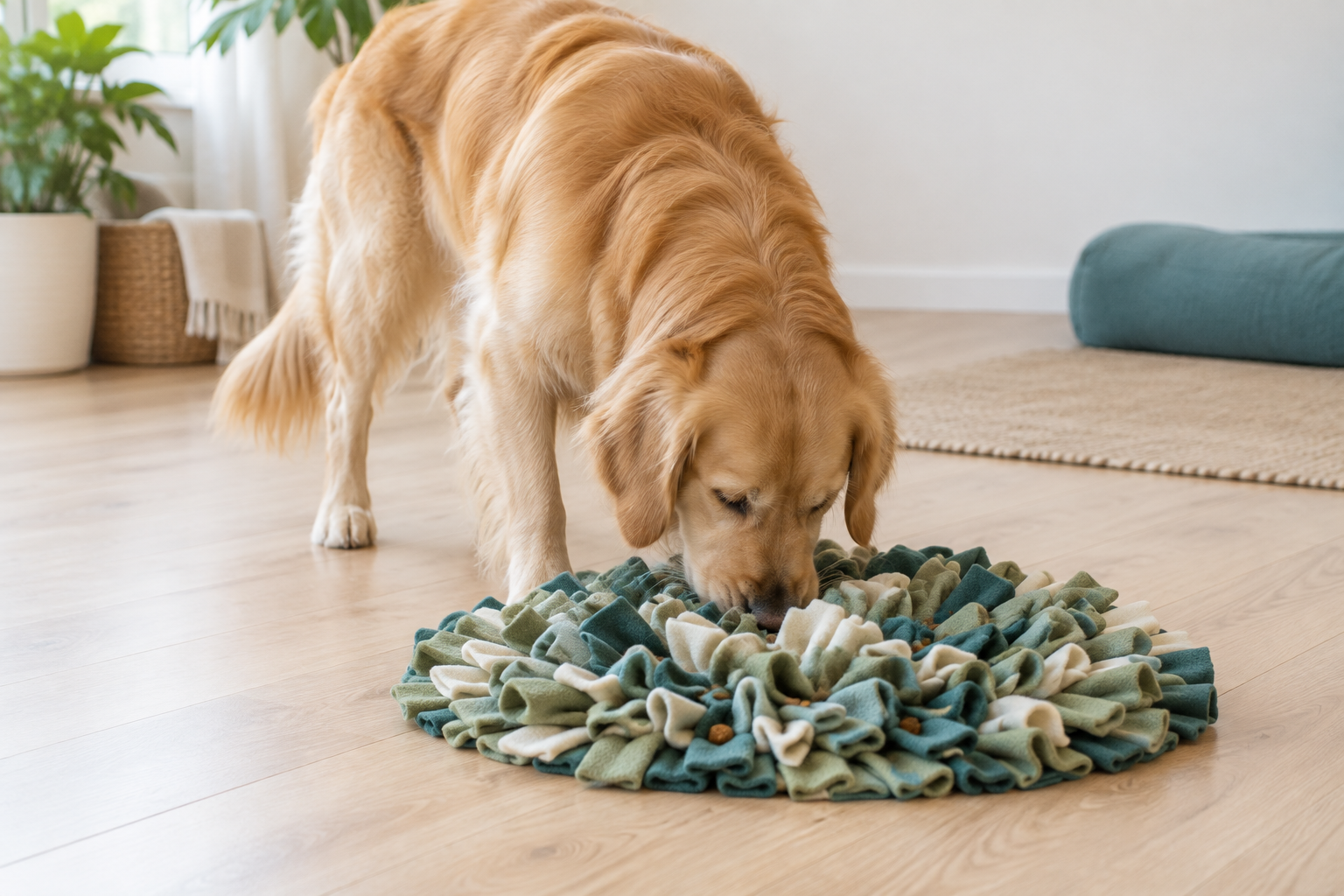
Snuffle mats, scatter feeding, and food searches
Spread a few pieces of the normal food allowance over a clean, safe floor or the top of a snuffle mat. For a simple search, let your dog see you place food in two or three reachable locations.
Make it easier. Keep all food visible and close together. Use a plain surface before adding fabric folds or hiding places.
Build gradually. Tuck food shallowly into the mat, spread the search slightly wider, or hide a piece just out of sight after your dog understands the game.
Keep it safe. Supervise mats and remove them if fabric is torn or eaten. Avoid contaminated ground, pesticide-treated areas, and places containing debris. Retrieve uneaten food and separate animals.
Slow feeders
A slow feeder places simple ridges between pieces of food. Choose a shallow design with enough room for your dog to reach the food comfortably.
Make it easier. Use fewer ridges, a wider dish, or only part of the meal in the feeder.
Build gradually. Change the food distribution before choosing a more complex design. A slower meal is useful only if eating remains comfortable.
Keep it safe. Check fit for the dog’s muzzle and watch for scraping, distress, or forceful chewing. Return to a regular bowl if access is uncomfortable.
Count food used in enrichment as part of the daily allowance, including fillings and treats. Divide meals between bowls and activities to avoid unintended weight gain. Follow prescribed diets and feeding advice; do not withhold needed food to force participation.
Training & Problem Solving
Learning itself can be enriching. Use short, reward-based sessions with an achievable goal. Stop while your dog is still comfortable and interested, rather than repeating a behaviour until they become frustrated.
Teach the Touch cue
Present an open hand a short distance from your dog’s nose. When your dog voluntarily touches it with their nose, immediately offer a reward they value. Move your hand away between repetitions. Once the movement is familiar, say “Touch” just before presenting your hand.
Make it easier. Reward a small movement towards the hand at first. Keep the hand close and avoid moving it into the dog’s face.
Build gradually. Vary the hand’s position a little. Later, use “Touch” to invite a simple movement or guide your dog towards a mat.
Keep it safe. Do not physically move the dog or lure them into uncomfortable positions. If hands are difficult for them, follow your behaviour team’s alternative.
Teach the Look cue
In a quiet, familiar place, wait for your dog to glance towards your face and immediately reward that response. Once they are offering brief glances comfortably, say “Look” just before an expected glance, then reward.
Make it easier. Stand or sit nearby and reward a brief orientation towards your face. A moment of attention is enough.
Build gradually. Gradually add a little duration or a mild distraction, changing only one feature at a time. Keep the cue easy to respond to.
Keep it safe. Do not demand prolonged eye contact, hold the dog’s face, or repeat the cue when they are uncomfortable. Reward a comfortable glance and allow them to look away.
Shaping, tricks, and new skills
Shaping means rewarding small steps towards a behaviour. For example, reward looking at a mat, then approaching it, then placing a paw on it. Reward frequently enough that the task remains clear. Simple tricks, finding a named toy, and learning to settle in a chosen resting place can all provide learning opportunities.
Problem-solving without pressure
For a searching task, hide a favourite toy partly in view and invite your dog to find it. For a discrimination activity, begin with one familiar object, then gradually teach a choice between two distinct objects. Keep the answer obvious at first and reward the correct choice. If mistakes accumulate, simplify the task instead of repeating the cue or correcting the dog.
Make participation voluntary where possible. Walking away, slowing down, or repeatedly offering unrelated behaviours can mean the task needs to be easier, shorter, or different. Training should not become repetitive drilling.
Scent & Sensory Enrichment
Sniffing can be an activity in its own right. Your dog does not need to cover a long distance for an outing to offer useful exploration.
Take a sniffari
A sniffari gives your dog meaningful opportunities to explore and sniff at their own pace. It can take place indoors, in the backyard, or on a walk. Distance, speed, and obedience are not the main objective.
Indoors, offer a safe room to investigate or place a few meal pieces in easy-to-find locations. In the backyard, allow exploration of safe areas and familiar scents. On walks, choose a quiet route and allow pauses and route choices where practical. Use suitable walking equipment and follow local leash requirements. Check yards for secure fencing, harmful plants, chemicals, and debris, and supervise. Avoid forcing your dog towards something they find frightening.
Start a simple scent search
Let your dog watch you place a few food pieces in a small, clear area. Invite them to search. Alternatively, partly hide a familiar toy that they enjoy finding.
Make it easier. Keep the food or object visible and close by. Search in a familiar room with few distractions.
Build gradually. Hide the object just out of view, expand the area slightly, or add one new location. Introductory nose work can build on these easy searches.
Keep it safe. Avoid inaccessible hiding places and areas with hazards. Use food appropriate to the diet. Do not introduce essential oils, irritants, or unknown scent substances.
Offer safe sensory choices
Explore a different quiet route, allow investigation of a clean unfamiliar object, or offer safe surfaces such as short grass and a non-slip mat. Let the dog approach at their own pace. Check objects for contamination, sharp edges, or chewable parts. New textures, sounds, and smells should be optional and mild; novelty that causes avoidance is not a benefit.
Physical & Play Enrichment
More exercise is not automatically better enrichment. Match movement to age, health, pain, mobility, fitness, and preference. A gentle exploration walk may suit one dog better than repeated fetching.
Interactive play
- For tug, use a suitably sized toy and gentle, predictable movement. Keep the dog’s feet on the ground and pause regularly. Avoid lifting, abrupt twisting, or forcing the toy from their mouth.
- For retrieve, start with short distances on a non-slip surface. Invite a comfortable return and exchange. Repeated high-speed stops, jumps, and turns may be unsuitable.
- For chase games, move a toy at a manageable speed and allow successful catches. Do not encourage chasing people, animals, or traffic. End if the dog becomes frantic or cannot pause.
Build a low-impact movement game
Use a clear room with a non-slip floor or a secure outdoor area with level, firm ground. Invite your dog to walk around a stable object or follow a target between two nearby points.
Make it easier. Use a wide route and a short distance. Keep every movement at ground level.
Build gradually. Add one broad turn or another familiar target. Body-awareness activities can involve slow, controlled stepping on suitable stable surfaces.
Keep it safe. Avoid unstable balance equipment, high obstacles, forced stretches, slippery surfaces, and uneven ground. Obtain individualized guidance before agility-type or balance activities if pain or physical limitations are present.
Play and explore outdoors
A secure backyard or another suitable outdoor environment can offer gentle tug, short retrieves, exploration, and movement games. Choose a quiet setting with enough space to pause or leave. Use a leash or suitable long line where needed, manage it to prevent tangling, and avoid high-speed play that could cause an abrupt stop at the end of the line.
Check fencing, gates, footing, and nearby hazards such as roads, wildlife, sharp objects, and other animals. Adapt activity to the weather and ground temperature; avoid excessive heat, icy or slippery surfaces, and strenuous activity beyond your dog’s fitness. Offer shade, water, and regular breaks, and supervise throughout.
Offer pauses and water, and stop if movement changes, fatigue develops, or the dog appears uncomfortable. Pain, reluctance to move, or a sudden change in activity warrants veterinary advice.
Environmental Enrichment
An enriching environment provides interesting choices and places to rest. It does not have to change constantly.
Create a Safe Haven
A Safe Haven is a comfortable indoor area where your dog can relax and withdraw without being disturbed. Choose a quiet location, provide familiar bedding, and introduce it gradually with rewarding experiences. Allow your dog to enter and leave freely where practical. Do not use the Safe Haven for punishment or forced confinement, and keep children and other animals from disturbing a resting dog.
Pheromones
A species-appropriate dog-appeasing pheromone product may be used in the indoor environment or near the Safe Haven as part of your veterinary behaviour team’s plan. Pheromones are chemical signals; synthetic products are intended to mimic some of these signals. Responses vary, and pheromones do not replace a comfortable environment, behaviour work, or prescribed treatment. Follow the product instructions and your team’s advice.
Create useful spaces
- Offer comfortable resting locations where your dog can be undisturbed. Allow a choice of proximity to people when practical.
- An observation area can be useful if watching is calm. Reduce the view if it leads to repeated barking, agitation, or vigilance. Any elevated location must be stable and safely accessible.
- Provide supervised outdoor exploration in a secure space. If your dog enjoys digging, offer a designated area with clean, safe material and check for sharp objects or contamination.
- Introduce a clean, robust novel object for investigation, with room to approach or leave. Remove it if it causes concern or is chewed apart.
Rotate activities while keeping familiar favourites
Keep a small selection of suitable toys available and rotate some periodically. Reintroducing a familiar favourite may be enough. Maintain predictable routines and access to preferred resting places. Enrichment does not require buying many toys or leaving everything out permanently.
Novelty is not automatically enriching. A fearful dog may prefer familiar environments, predictable activities, and repetition. Offer new experiences gradually and never force investigation.
Social Enrichment
Social enrichment may include a shared walk, cooperative play, quiet time nearby, or affection that your dog seeks. Familiar people or compatible dogs may be welcome companions, but social contact is not a requirement for every activity.
Choice and control
Allow your dog to approach, disengage, move away, and influence the duration or intensity of contact. During petting, pause and see whether they choose to return. Moving away is a reason to stop, not an invitation to follow.
When social interaction is not enrichment
An interaction is not enrichment when your dog is frightened, uncomfortable, frustrated, over-aroused, unable to disengage, or trying to leave. Examples include:
Support comfortable interactions
Choose companions and settings that your dog already finds comfortable. Build in pauses during play and maintain space to separate. Supervise children directly and ensure the dog has an undisturbed retreat. Owner attention, toys, and preferred activities can create competition; provide them separately when needed.
Do not force animals to share or “work it out”. Staring, blocking, stealing, guarding, chasing, or one animal withdrawing are reasons to change the arrangement. See multi-animal households.